

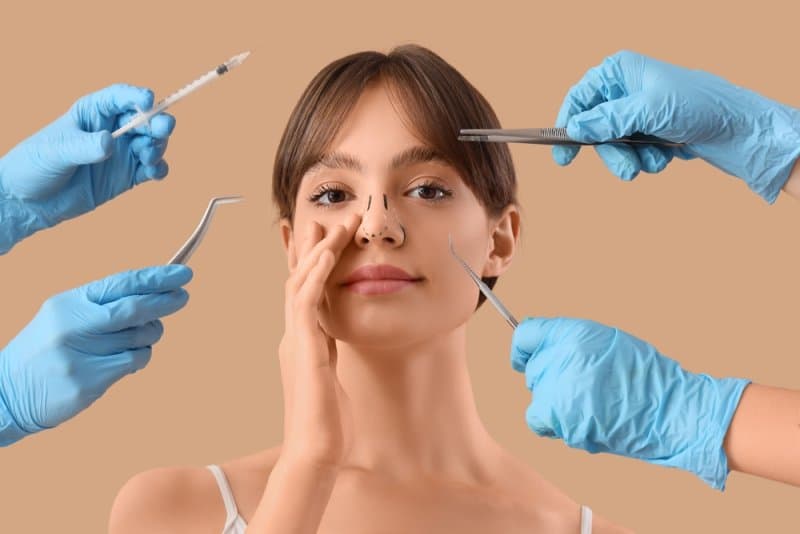
Your nose also affects the looks and functioning of your face. Babar nose reconstruction can restore the nose following removal of tumors or damage. It can also change a nose after a failed prior operation.
Nose reconstruction surgery involves reconstructing the nose with tissue grafts and reconstructing the nose's shape. Learn about nasal reconstruction methods, the surgical procedure, and recovery so you can decide with your doctor.
Nasal reconstruction surgery repairs missing or damaged tissue of the nose and brings the nose back to its natural shape and function. It can be indicated following excision of skin cancer, trauma, infection, or surgery.
The main distinction is what the procedure is intended to do: Cosmetic rhinoplasty is sometimes performed to change the appearance of the nose. Nasal reconstructive surgery is often used to restore missing tissue and structures. In many cases, the surgeon will reconstruct the external skin, the internal nasal lining, and the cartilage or bone.
Depending on the location, size, and depth of the wound, the nasal reconstruction after skin cancer removal (such as Mohs surgery) may involve the tip, the nostrils, the bridge, or sides of the nose. The nasal defect reconstruction depends on the wound size and depth; a small surface wound needs only to be skin-covered; a deep wound may need cartilage and lining reconstruction.
Prior to choosing the approach, the surgeon looks at the remaining tissue, the blood flow to the tissue, the shape of the nose, and the distance of the defect to the nose. The target is to restore the patient's confidence with a natural appearance without narrowing of the nostrils and without impairment of breathing.
There are many methods for reconstructing nasal defects. The appropriate technique depends on the extent of missing tissue, type and quality of skin, and absence of cartilage or internal lining.
A nasal skin graft uses another part of your body's healthy skin to replace skin lost on the nose. The skin can be taken from behind the ear, the forehead, or elsewhere.
A nasal skin graft may be useful in smaller and somewhat shallow defects that have sufficient remaining healthy tissue below to sustain healing. Grafts may vary from the surrounding nasal skin in color, thickness, and texture and cannot replace missing cartilage on their own.
This type of flap to repair the nose involves the movement of a healthy, available skin that is still attached to its original blood supply. The doctor raises the healthy skin, moves it to the defect site, and then reattaches it.
This method may offer an improved match of skin color and texture versus a graft. Nasal flap reconstruction is usually reserved for defects where surrounding tissue is available. Depending on the size and location of the wound, surgeons may employ local flaps or tissue from adjacent facial regions.
Nasal reconstruction with a forehead flap is suitable for larger and more complicated defects involving the tip or more than one part of the nose. This technique involves taking tissue from the forehead while still attached to its blood supply with a tissue bridge called a pedicle.
This operation can be staged. The transferred tissue must establish a reliable blood supply, and, at a subsequent operation, the pedicle is divided; other stages may include refinement of the contour or thickness of the reconstructed nose.
A forehead flap nasal reconstruction involves taking skin and tissue from the forehead to form the nose. A forehead flap is a safe way to create skin tissue for a nose, because the skin of the forehead is usually similar in color, thickness, and texture to that of the nose.
Most surgeons choose the paramedian forehead flap for a wide range of nasal reconstruction. It has sufficient tissue to adequately cover a large area and a good, reliable blood supply. If the cartilage or mucosal lining is not available, additional tissue grafts or flaps may need to be taken to construct the entire nose.
Healing time will differ depending on the specific procedure, the size of the defect, and the overall health of the patient. The wound will be repaired with a skin graft or local flap repair; these require only weeks for healing, but swelling, redness, and scar maturation may take many months.
More complex nose repair surgeries can take several months to finish because they may involve more than one operation. If the surgeon has to take a forehead flap, then there will normally be a time delay between the surgeries to allow the tissue that has been transferred to the face to develop a blood supply. Patients have to follow wound healing instructions and keep follow-up appointments.
A successful nasal reconstruction does not only mean that it covers the open wound. Rather, three critical structural layers must be taken into account:
The result is also influenced by blood flow, wound healing, medical status, and the surgeon's level of experience. The patient may require additional minor re-operations for better nasal contour, symmetry, or breathing.
Nasal reconstruction surgery, or nose reconstruction, is used to rebuild the shape and function of the nose following removal of a cancer, injury, or other type of tissue loss.
Whether considering a nasal skin graft, a nasal flap reconstruction, or a forehead flap procedure, a nasal defect will be approached with a specific technique based on the defect's size.
Yes! Reconstruction can be performed as soon as possible following the injury when the wound is clean, and the tissue in the surrounding area is sufficient. In some cases, reconstructions are delayed because of infection, contamination, or tissue loss.
Scarring can occur because of surgery and transfer of tissue. Nevertheless, your doctor will try to strategically place the incisions and areas of donor tissue to make the scars less visible. The scars will typically fade over time with the healing process but can vary from patient to patient.
Yes, if nasal damage involved damage to your nostrils, lining of your nose, or cartilage that supports your nose, reconstruction can provide breathing improvements. Structural grafts may be placed to hold open your airways. The success of any breathing improvement depends on the problem that was found during surgery.
The anesthesia type is determined by the general magnitude of the procedure to be performed and the length of time it will take, as well as the patient's overall medical condition. Smaller repairs can be done under local anesthesia; large reconstructive procedures involving several tissue layers are likely to require general anesthesia.
The tissue can settle and move as the swelling diminishes and the scars mature further. Occasionally, the patient may notice a change in the shape of the contour, or the scars may undergo a small tightening. In many instances, it is at the follow-up appointment that the surgeon can tell which way the change is headed.
This content was created by AI